Almost every firearm in Escape from Tarkov can be taken apart and rebuilt. Most of what a weapon does in your hands comes from the parts on it. This page explains the numbers, then the parts, then what goes wrong with a weapon and how to fix it. The round you load is a separate choice: see Ammo and penetration.
The numbers on a weapon
| Value | What it does |
|---|---|
| Ergonomics | Higher is better. It decides how fast you aim down sights, how loud aiming is and how fast stamina drains while you aim |
| Weight | A heavier weapon aims slower and drains stamina faster while you aim |
| Vertical and horizontal recoil | How far the weapon climbs and how far it bounces sideways when fired. Lower is better |
| Accuracy | Given in MOA. Lower means a tighter group |
| Muzzle velocity | Faster bullets drop less |
One MOA is about an inch at 100 yards. The game treats the number as a radius rather than a width, so the real group is twice as wide as the figure suggests: a 1 MOA weapon groups in about 5.8 cm at 100 metres.
How parts change them
Every part page lists what the part adds or takes away. Ergonomics is in points. Recoil, accuracy, heat, cooling and durability burn are percentages.
The usual trade is recoil against ergonomics. Take the AK-74N, listed with 48 ergonomics, 71 vertical recoil and 181 horizontal recoil:
| Slot | Part | Ergonomics | Recoil | Sold by |
|---|---|---|---|---|
| Stock | AK-74 wooden stock | +3 | −21% | Prapor, level 1 |
| Stock | Hexagon Kocherga stock | +24 | −18% | Skier, level 3 |
| Stock | Magpul Zhukov-S stock | +15 | −23% | Peacekeeper, level 4 |
| Muzzle | AK-74 muzzle brake | −0.5 | −5% | Prapor, level 1 |
| Muzzle | Zenit DTK-1 muzzle brake | −2.5 | −11.5% | Skier, level 3 |
| Muzzle | JMac RRD-4C muzzle brake | −4.5 | −13% | Mechanic, level 3 |
| Muzzle | TGP-A sound suppressor | −18 | −7% | Prapor, level 3 |
Parts also nest. On the AK-74N the handguard does not attach to the rifle but to the gas tube, and foregrips and tactical devices then attach to the handguard. A weapon page lists what fits each of its slots, and a part page lists what fits onto that part.
What each type of part is for
| Part | What it changes |
|---|---|
| Barrels | Recoil, ergonomics, accuracy, muzzle velocity, heat, cooling and durability burn |
| Stocks | The largest lasting recoil reductions, up to 35% |
| Handguards | Mostly ergonomics, from +2 to +22. A few lower recoil by up to 3% |
| Pistol grips | Ergonomics, up to +10, and at most 1.5% recoil |
| Foregrips | Ergonomics, up to +12, or recoil, up to 3.5%. The ones that cut recoil most cost 2 ergonomics |
| Muzzle brakes and flash hiders | Recoil, up to 20%, almost always for some ergonomics |
| Suppressors | A quieter shot and up to 15% less recoil, paid for in ergonomics, heat and durability burn |
| Bipods | 65% to 80% less recoil, only while the weapon is mounted on the bipod |
| Mounts | Rails and rings that other parts need |
| Tactical devices and flashlights | Lights and lasers, visible or infrared. They cost 1 to 2 ergonomics |
Muzzle devices
Brakes, flash hiders, suppressors and adapters share the muzzle slot. An adapter is a thread for another device: the SilencerCo Hybrid 46 adapter goes on the AK-74N's muzzle so that the Hybrid 46 suppressor, which does not fit the rifle itself, can be screwed onto it.
Suppressors raise heat and durability burn, so a suppressed weapon overheats sooner and wears faster.
| Mod | Ergonomics | Recoil | Heat | Durability burn | Weight | Sold by |
|---|---|---|---|---|---|---|
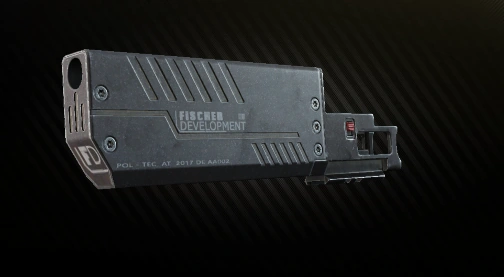 Glock 9x19 Fischer Development FD917 sound suppressor | -2 | -15 | 12 | 43 | 0.35 kg | Mechanic LL3 |
 9A-91 9x39 sound suppressor | -4 | -14 | 14 | 20 | 0.496 kg | Prapor LL2 |
 AS VAL 9x39 integral barrel-suppressor | -5 | -14 | 24 | 52 | 0.496 kg | Prapor LL4 |
 SR-3M 9x39 sound suppressor | -5 | -14 | 14 | 36 | 0.575 kg | Prapor LL4 |
 VSS 9x39 integral barrel-suppressor | -5 | -14 | 24 | 49 | 0.496 kg | Prapor LL3 |
 SilencerCo Salvo 12 12ga sound suppressor | -28 | -13 | 18 | 75 | 0.97 kg | Mechanic LL4 |
 AI .338 LM Tactical Sound Moderator | -25 | -11 | 25 | 115 | 0.665 kg | — |
 AS VAL MOD.4 9x39 integral barrel-suppressor | -4 | -11 | 25 | 51 | 0.279 kg | Mechanic LL4 |
 ASh-12 12.7x55 sound suppressor | -17 | -10 | 16 | 45 | 0.7 kg | Prapor LL4 |
 MPX 9x19 Ronin Arms 12 inch SD Suppressor | -6 | -10 | 10 | 39 | 0.427 kg | Peacekeeper LL2 |
| Mod | Ergonomics | Recoil | Accuracy | Heat | Weight | Sold by |
|---|---|---|---|---|---|---|
 ASh-12 12.7x55 muzzle brake | -5 | -20 | 0 | -1 | 0.15 kg | Prapor LL4 |
 Mosin Rifle Witt Machine 7.62x54R muzzle brake | -5 | -20 | -1 | -1.3 | 0.17 kg | Jaeger LL3 |
 Tromix Monster Claw 12ga muzzle brake | -7 | -19 | 0 | -2 | 0.34 kg | Mechanic LL3, after completing his quest Gunsmith - Model 870 |
 SilencerCo AC-858 ASR .338 LM muzzle brake | -1 | -18 | 1 | -1.1 | 0.11 kg | Jaeger LL4 |
 Glock 9x19 Lone Wolf AlphaWolf Bullnose compensator | -7 | -17.5 | -1 | -1 | 0.063 kg | Mechanic LL1 |
 Mosin Rifle Texas Precision Products 7.62x54R muzzle brake | -5 | -16 | 3 | -1 | 0.19 kg | Jaeger LL2 |
 Glock 9x19 CARVER Custom 4 Port compensator | -5 | -15 | 2 | -1 | 0.036 kg | Mechanic LL3 |
 PK Zenit DTK-1P 7.62x54R muzzle brake | -4 | -15 | 1 | -1.3 | 0.124 kg | Skier LL4 |
 AK-74 thread type JMac Customs RRD-4C multi-caliber muzzle brake | -4.5 | -13 | — | -1.3 | 0.085 kg | Mechanic LL3 |
 AKM thread type JMac Customs RRD-4C 7.62x39 muzzle brake | -4.5 | -13 | — | -1.6 | 0.08 kg | Mechanic LL4 |
Sights
The types are iron sights, reflex sights, compact reflex sights, assault scopes, scopes, thermal sights and night vision scopes. Each sight page gives its zeroing distances and sighting range.
- Compact reflex sights weigh 25 to 130 grams and cost half a point of ergonomics at most.
- Reflex sights cost 1 to 6 ergonomics, assault scopes 2 to 5, scopes 1 to 10 and thermal sights up to 20.
- Most riflescopes need a ring mount of their tube diameter. The March Tactical 3-24x42 is a 30 mm scope and goes into any of nine 30 mm mounts.
- Thermal sights also list a refresh rate: how many times a second the picture updates.
| Mod | Ergonomics | Sighting range | Zeroing distances (m) | Weight | Sold by |
|---|---|---|---|---|---|
 Trijicon RMR reflex sight | 0 | 150 m | 25, 50, 100 | 0.025 kg | Peacekeeper LL2 |
 Trijicon SRO reflex sight | 0 | 150 m | 25, 50, 100 | 0.025 kg | Peacekeeper LL3 |
 Trijicon MRO reflex sight | -0.5 | 150 m | 25, 50, 100 | 0.116 kg | Peacekeeper LL2 |
 SwampFox Justice reflex sight | 0 | 150 m | 25, 50, 100 | 0.025 kg | Ref LL2, after unlocking it in Arena BattlePass Season 1 |
 Strike Industries Hexion Tech Seeker reflex sight | — | 150 m | 25, 50, 100 | 0.04 kg | Ref LL3, after unlocking it in Arena BattlePass Season 3 |
 SIG Sauer ROMEO4 reflex sight | 0 | 150 m | 25, 50, 100 | 0.089 kg | Peacekeeper LL2 |
 Leupold DeltaPoint Reflex Sight | 0 | 150 m | 25, 50, 100 | 0.053 kg | Peacekeeper LL2 |
 DI Optical FC1 reflex sight | — | 150 m | 25, 50, 100 | 0.13 kg | Ref LL2, after unlocking it in Arena BattlePass Season 2 |
 Burris FastFire 3 reflex sight | 0 | 100 m | 25, 50, 100 | 0.025 kg | Peacekeeper LL1; Skier LL2 |
 BelOMO PK-06 reflex sight | 0 | 100 m | 25, 50, 100 | 0.09 kg | Jaeger LL1 |
 Aimpoint Micro T-1 reflex sight | 0 | 150 m | 25, 50, 100 | 0.084 kg | Peacekeeper LL2 |
 Aimpoint Micro H-2 reflex sight | 0 | 150 m | 25, 50, 100 | 0.094 kg | Peacekeeper LL1 |
 Aimpoint ACRO P-1 reflex sight | 0 | 150 m | 25, 50, 100 | 0.06 kg | Peacekeeper LL1 |
Magazines
A bigger magazine costs ergonomics and feeds less reliably. Four magazines for the AK-74 family show the pattern:
| Magazine | Rounds | Ergonomics | Failure to feed | Sold by |
|---|---|---|---|---|
| 6L20 | 30 | −1.5 | Very low | Prapor, level 1 |
| 6L26 | 45 | −4 | Low | Prapor, level 3 |
| 6L31 | 60 | −10 | Medium | Ref, level 3, and Prapor, level 4 |
| RPK-16 drum | 95 | −12 | High | Ref, level 3 |
All of them are on the 5.45x39mm magazine list.
Malfunctions
When a weapon malfunctions, the bottom right corner of the screen flashes. Inspect the weapon (L by default) to learn which malfunction it is, then clear it (Left Shift + T by default).
| Malfunction | What happens | Main causes |
|---|---|---|
| Misfire | You pull the trigger and the round does not fire | None listed |
| Failure to eject | The spent case is caught by the bolt | The weapon's condition, less often overheating or the round |
| Failure to feed | The next round gets stuck on its way in | The magazine, above all high-capacity and drum magazines. Also the round, overheating and condition |
| Jammed bolt | The bolt sticks after a shot | Overheating or condition. A hard jam takes longer to clear and only happens at 5% condition or less |
These mechanical malfunctions do not happen while a weapon is above 93% durability. Overheating can still jam the bolt. Troubleshooting makes clearing faster, and at elite level you no longer have to inspect first.
If your primary weapon jams while you carry a secondary with a round chambered, you get 5 seconds in which you can switch to it immediately. The secondary slot flashes blue.
Overheating
Every shot heats the weapon, and it cools all the time. How fast it heats depends on the round, the barrel and parts such as the receiver, the muzzle device and the handguard. How fast it cools depends on the same parts. Each stage adds to the one before:
- Slight. The heat shows in thermal sights and can cause a heat haze over the barrel.
- Medium. The barrel glows red. Accuracy drops, malfunctions and wear rise, and the maximum durability falls as you keep firing.
- Severe. The rate of fire changes and a round can cook off.
- Maximum. The bolt jams.
Repairs
| Repaired by | Quality | Cost |
|---|---|---|
| Weapon repair kit | 1.05 | About 0.5 |
| Prapor | 0.83 | 0.83 |
| Skier | 1 | 1 |
| Mechanic | 1.43 | 1.23 |
The numbers are multipliers: higher quality is better, higher cost is dearer. Quality matters less for weapons than for armor, which makes the kit the usual choice. Skier and Mechanic charge more as your loyalty level with them rises. Prapor's price stays the same.
Repair kits need the Workbench at level 1. Upgrading it to level 3 improves the result, and so do the Intellect and Weapon Maintenance skills. Weapon Maintenance also cuts the wear from shooting by 0.5% per level.
Mastering and skills
Using a weapon trains it. Every hit on a target in an online raid gives 1 point of mastering, and each pellet of a shotgun shell counts. Weapons built on the same platform share one mastering track. Level 2 or level 3 brings a new reload animation, depending on the weapon, and level 3 lets you reload while aiming down sights.
| Platform | Points for level 2 | Points for level 3 |
|---|---|---|
| ADAR 2-15, M4A1, HK 416, TX-15 | 1,600 | 2,000 |
| AK-74, AK-100 series, RPK-16, RD-704, SAG AK | 2,000 | 2,200 |
| AKM, VPO | 500 | 600 |
Each weapon class also has a skill. Assault Rifles, for example, gives 0.4% reload speed, 0.3% less recoil and 0.2% ergonomics per level, and doubles mastering gain at elite level. The rest are on the combat skill list.
Related pages
- Gunsmith tasks: the builds Mechanic asks for, part by part.
- Ammo and penetration
- Armor
- Hideout: the Workbench.